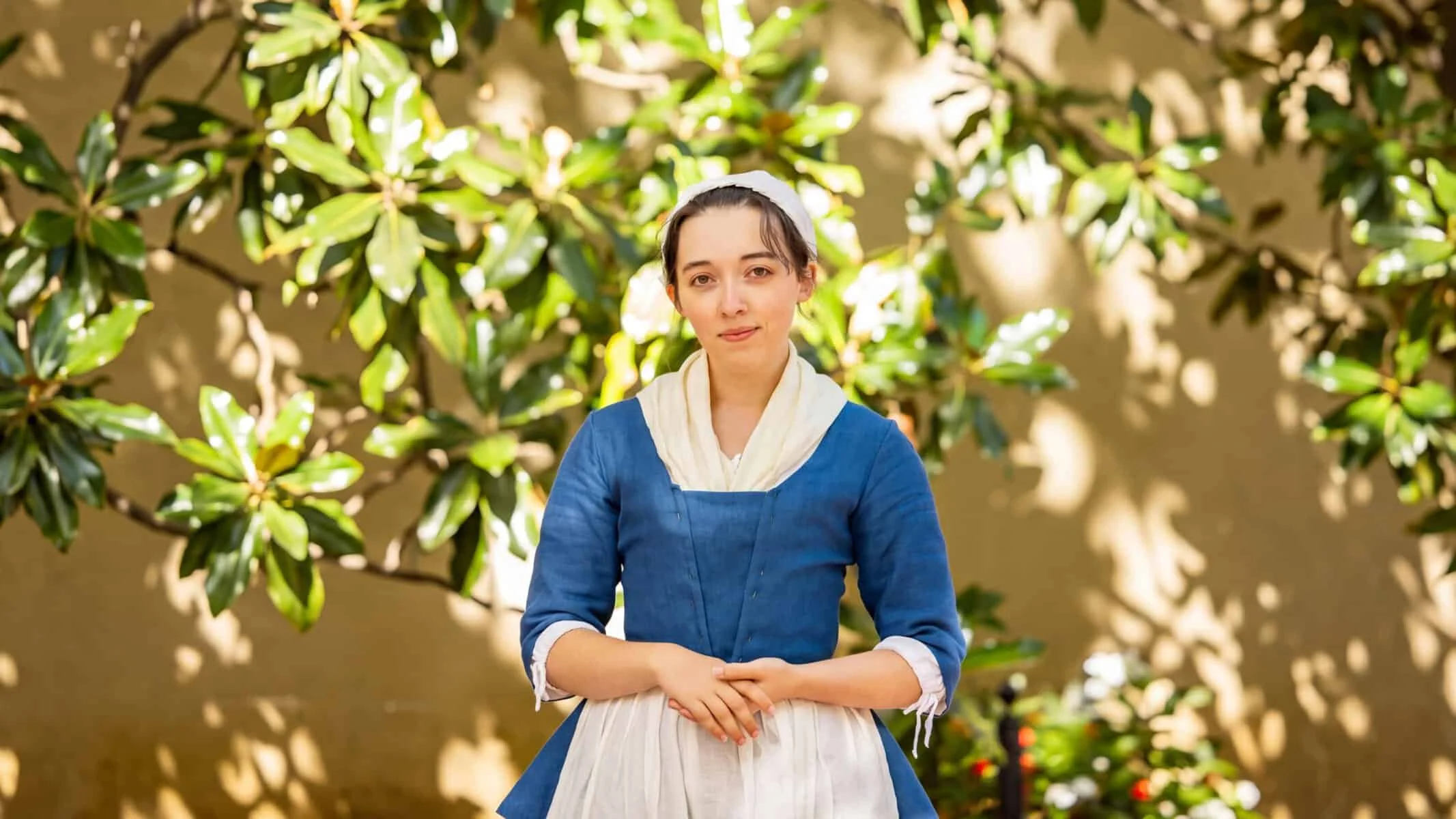
The Betsy Ross House at 239 Arch Street is known for its place in Philadelphia’s history, but its daily interpretation also turns attention to the work of making a home. For Madeline Burk, a Betsy Ross History Maker with Historic Philadelphia, portraying Ross means learning how clothing, upholstery, tools and personal choices shaped life in the 18th century.
Burk came to the role from within the organization, where she had already worked as a storyteller. Her route into the character included a historical storytelling audition, questions about instruments and memorization, and a practical sewing test. The last part proved the most unnerving: she had to sew a straight running stitch in linen. “I did not do very well, I confess,” she recalled.
That early test now sits in sharper relief against the practical skills she has built at the house. Burk and other History Makers sew objects for the museum and for other institutions, from miniature bedding to curtains for a camp bed at Fort Ticonderoga. The work gives visitors a view of history through objects that were made, repaired and used, rather than through dates alone.
Building a character through research and routine
Burk was drawn to Ross because the historical figure was both ordinary and consequential. The surviving information about her is limited, Burk said, but it still offers clues to Ross’s character: what she valued, how she behaved and how firmly she held to her beliefs. That mix gives an interpreter room to build a performance while staying anchored in the known record.
Costume is part of that process. Getting dressed involves corsetry, which changes how Burk moves, breathes and sometimes speaks. Once her hair is arranged beneath a cap, she says, looking in the mirror helps her feel like a different person. The shift continues in her posture and voice. As Ross, she becomes more deliberate about how she speaks and carries herself.
Visitor questions test that preparation in real time. Burk says training gives her a substantial store of information about Ross and the period, so she can usually find a response. When someone tries to make her break character, she considers how Ross might answer: perhaps with teasing, a mild scold or a laugh. When a question falls outside Ross’s experience, Burk can acknowledge that plainly. Ross, after all, would not have known every detail about a ship captain’s or candle maker’s work.
Upholstery as a link between the house and its history
Burk didn’t expect 18th-century upholstery to become such a large part of her work. At the house and in its shop, History Makers sew and produce pieces for the museum and other museums. The craft has also given her skills she can use beyond the historic site, including repairing small furniture and clothing at home.
Some of her favorite projects have been made for doll beds. The team created mattresses stuffed with horsehair and curtains from cotton chintz, complete with valances. Burk likes that the bed curtains differ from one another and call for different techniques. Their variation makes a practical point: household textiles could be tailored to a particular bed and owner, and skilled handwork shaped how a room felt.
The team has also made curtains for a camp bed at Fort Ticonderoga and sewn flags. Burk’s advice for flag construction comes from the realities of handling long lengths of fabric: use running stitches for the felled seams. A back stitch followed by a whip stitch can make corrections difficult; running stitches make it easier to undo work when a mistake happens. Her broader lesson is just as useful: expect to make errors, then be willing to repair them.
A personal story inside a famous home
Among the stories Burk most enjoys telling is how Ross met her first husband, John Ross. They encountered each other while training as upholsterers. In Burk’s telling, the young apprentices noticed one another across the room, exchanged glances and looked away. Their friendship grew during the apprenticeship, although their religious differences created a barrier: Ross was Quaker, while John was Anglican.
They eventually chose to marry, eloping at a tavern in New Jersey before returning to Philadelphia. Ross was read out of her Quaker meeting and became Anglican for several years. For Burk, the story reveals a woman who made a difficult personal decision and stood by it. She describes Ross as stubborn, feisty and rebellious, with a strong sense of what she believed.
That account gives the house a human scale. The famous name belongs not only to a public story but to a person whose work, relationships and choices took place in ordinary settings. Burk says Ross married three times and was buried three times. She also never owned property; she was always a renter. In a house visited for its connection to a nationally recognized figure, those details complicate the picture of what it meant to make a home.
What a home might have meant to Betsy Ross
Asked to imagine Ross’s ideal home, Burk pictures a comfortable place filled with upholstered goods—perhaps more luxurious than Ross could afford. She doesn’t imagine an extravagant residence, though. The home would be modest, suited to family life and work, and comfortable enough for Ross to be herself.
That idea fits the craft on display at the house. Upholstery and sewing were skilled work, but they were also part of the material life of a home: curtains, bedding and furniture shaped the rooms people lived in. At 239 Arch Street, those details offer a way to connect a historic address with the labor behind domestic comfort.
Burk sees that connection as one reason in-person history still matters. The past can help people recognize patterns that return in new forms, she said, while art, literature and human connection remain difficult to reproduce through technology. Her work brings that argument down to the scale of a stitch, a garment or a visitor’s question. The lasting appeal of the Betsy Ross House may lie in that close view: history becomes more tangible when people can see the work and hear how one interpreter makes sense of it.
Visit the Betsy Ross House
Information about the historic property is available at Betsy Ross House on Redfin. More properties featured in Redfin’s Iconic Homes of America series are listed at Redfin Presents Iconic Homes of America.
Readers can also find mortgage information at redfin.com/afba and Redfin’s prequalification page.
===