Three major projects show how historic buildings can take on cultural and educational uses: London’s former Smithfield General Market and Brussels’ Citroën Garage have opened as museums, while a renovated Victorian infirmary in Edinburgh has received Scotland’s top building award. Each project starts with a structure built for a different purpose and asks what can be retained, what needs to change, and how the result can serve people now. That’s a practical question for cities with prominent old buildings and pressure to give them useful lives. The answers here range from exhibition space to university teaching and work spaces.
Market halls become museum space
After a decade of work, the 1880s Smithfield General Market has reopened as the London Museum. Stanton Williams, Asif Khan and Julian Harrap Architects transformed the Victorian structure into two principal gallery spaces: an airy upper gallery and a subterranean exhibition area set at Roman street level. Both present artefacts from London’s history, placing the museum’s subject inside a building that is itself part of the city’s past. The two levels also give visitors distinct settings for encountering the collection, rather than treating the market as a neutral container for displays.
That distinction matters in conversions of large historic buildings. The architecture can help a museum tell its story, but it also has to support the basic work of exhibiting objects and moving visitors through the space. Smithfield’s upper and lower galleries suggest one way to work with the building’s different levels and histories. The design’s challenge is to make those layers legible without allowing the old structure to overwhelm the material being shown.
Brussels’ Kanal museum offers a larger conversion, occupying 40,000 square metres in a former 1930s Citroën garage. Atelier Kanal renovated the building and inserted three new volumes into its structure to create a museum for modern art and architecture, with exhibitions developed with Paris’s Centre Pompidou. The project describes itself as “Europe’s largest museum development”. Its scale makes the relationship between the existing garage and the new museum spaces central to the project: visitors encounter both the industrial building and the facilities placed within it.
In both cities, reuse gives a public institution access to a substantial existing structure, while the building brings its own character to the institution. That arrangement can be compelling, but it isn’t automatically successful. A conversion has to make the old building workable for its new role and give visitors a clear experience of the place. Here’s the thing: the museum use is only part of the story; the quality of the adaptation will shape whether the former market and garage feel like active civic spaces or simply impressive shells.
Edinburgh’s former infirmary earns top award
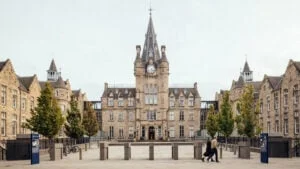
The Royal Incorporation of Architects in Scotland named the Edinburgh Futures Institute the 2026 winner of the Andrew Doolan Best Building in Scotland award. Bennetts Associates renovated the Category A-listed Victorian building, once an infirmary, and adapted it for teaching and work spaces for the University of Edinburgh. The conversion gives a former healthcare building a new institutional role, linking the history of the site to the university’s current needs. Its award also puts the project in a wider conversation about how heritage buildings can remain in use.
Universities often need a mix of spaces for teaching, collaboration and day-to-day work, while historic buildings may have layouts and fabric that weren’t designed for those activities. The difficulty is to make the new use function well while keeping the qualities that made the building significant. In Edinburgh, the project’s continued institutional use provides a clear purpose for the renovation. That said, recognition from an architectural award doesn’t, by itself, explain how every space performs for the people who use it.
This is more significant than it looks: an award-winning conversion can make a case for treating heritage as working infrastructure, rather than as an object to be preserved at a distance. The balance is delicate. New uses can sustain a building, but the changes required to support them also shape how its history is experienced.
Design and residential projects in focus
IKEA named Wild Fig, a deep reddish-purple, its Colour of the Year for 2027. The retailer said the shade “unexpectedly fits in” across furnishings and accessories, or when used on walls. A colour announcement is a small signal of how design attention moves from large public projects into the home: the same choice can be presented as a detail on an object or as a defining surface. The claim that it fits in widely is a retail pitch, though, and how a shade reads will depend on the room and the materials around it.
Dezeen Awards emerging architect of the year Kuma&Elsa has completed projects including a house in Japan and a bathing pavilion for Expo 2025 Osaka. Emerging designer of the year Simon Skinner’s work includes sculptural lights made from secondhand glassware and afro combs. These examples put architectural practice and product design alongside each other, with different scales and sources of material. One works through buildings and public settings; the other turns familiar objects into components of a new design.
Among the residential projects drawing attention were a Maryland house punctuated by lightwells and a renovated Yorkshire home designed to evoke a wine bar. A Doha art gallery featuring kaleidoscopic patterns also attracted interest. The descriptions point to a broad appetite for interiors and buildings with a strong visual idea, whether that idea comes from openings in a house, an adopted atmosphere or patterned surfaces. A memorable concept can make a project easy to describe, but the more useful question is how that idea shapes the experience of being in the space.
The week’s podcast examined debate around trees on buildings, alongside novelty streetwear and the Shanghai Grand Opera House controversy. The subjects differ, but each touches on how design choices are judged once they enter public view: as part of a building, a product, or a wider debate about architecture. (And this is the part most people overlook.) Attention can bring visibility, but it can also turn a project into a shorthand for arguments that extend beyond its design.
What these projects suggest
Together, the week’s stories show architecture being discussed through reuse, award recognition, domestic design and public response. The museum and university projects make the clearest case for adaptation: each gives an existing building a new institutional purpose, while the residential and design stories focus on how spaces and objects communicate character. The range is useful, but it shouldn’t obscure the different tests each project faces. A museum must support exhibitions and visitors; a university building must work for teaching and daily activity; a home must serve its occupants.
If you’re working in this space, the question to carry forward is how the design idea holds up in use. Historic fabric can add depth to a new institution, and an expressive interior can give a home a distinctive identity. Yet neither reuse nor visual impact guarantees a good result. The details of how people move through, occupy and understand these places will decide whether the ideas last beyond the opening or the headline. That’s the test.