The Brooklyn jobsite behind Wednesday's fatal collapse was not a first-time problem for the city. Before the building came down, the site had already violated a stop-work order from the New York City Department of Buildings (DOB). That history is going to shape the next few weeks of scrutiny, and it should.
The collapse killed eight people, including two construction workers, according to New York City Mayor Zohran Mamdani, who spoke at a press conference Thursday. Eighteen more people were injured.
A paper trail of violations
The DOB's record on this project starts in March. On March 20, during demolition, inspectors found inadequate overhead protection for some surrounding properties in the Flatbush neighborhood. The agency filed a stop-work order and a violation on the spot. The DOB confirmed those details to Construction Dive by email.
The site didn't stay quiet for long. When inspectors returned on April 23, they found demolition had resumed anyway. That produced a second violation. The DOB lifted the order on May 8, after the project team corrected the conditions that triggered it.
Here's the uncomfortable part. A stop-work order that gets lifted and then followed by a second violation within weeks raises the question of how closely the site was actually monitored once the order came off. The DOB's public record doesn't answer that. It shows the sequence, not the reasons crews kept pushing ahead.
The city goes after the network
After Wednesday's collapse, the DOB issued another stop-work order. That order says the jobsite had "unsafe construction operations causing" the collapse. It's a direct statement of cause from the regulator, and it's the kind of language that tends to show up later in enforcement actions and litigation.
Mamdani's response went beyond this one site. He pointed to five main entities tied to the project, which he said are linked to roughly 100 other sites across the city. "Our Department of Buildings is commencing sweeps of those sites today," he said. He added: "if there is anyone or any entity operating in this city that bears responsibility for what happened, we will hold them fully accountable."
That's a broader move than a single-site enforcement action, and it's worth watching. If you're working on a project with any overlap with those five entities, expect inspectors to look harder than usual.
Permits reviewed by Construction Dive list Robert Fischman of W6 Facility X as the owner and Cheng-Yi Lin Architecture as the architect of record. Neither could be reached for comment by the time of publication.
Dense construction is the norm, and that's the problem
Experts were quick to point out that deep excavation next to occupied buildings is routine in New York. Joe DiPompeo, president of New Jersey-based civil engineering firm Structural Workshop, said he could see supportive excavation had been installed next to a large hole adjacent to the site. In his view, that's a necessary practice in a city he described as mostly "tight buildings one on top of the other."
"There's nothing unusual about digging a hole next to a 100-year old brownstone townhouse in the city," DiPompeo said. He also pushed back on the idea that excavation crews had directly damaged the neighboring building, a theory that has circulated since the collapse.
He was blunt about the public reaction. "People that aren't used to dense urban construction are jumping on this. 'They were digging next door,'" DiPompeo said. "But what they were doing here, there's probably 500 other sites in the city that got the same thing going on."
That said, his argument has a sharp edge. Shoring is what keeps dense urban digs from turning into disasters, and when it fails, the consequences are immediate. "If the supportive excavation, the soil bracing were to fail or not do what it was supposed to do, the building that fell into the hole would fall into the hole exactly the way it did," he told Construction Dive.
Timothy Hegarty, a construction lawyer and partner at Zetlin & De Chiara, put the stakes in simpler terms. New York's building codes exist for a reason, he said, and the reason is physical. "We've got new construction frequently that takes place inches from century-old buildings, so the margin of error can be extraordinarily small," Hegarty said.
He also offered a reassurance of sorts. Tragedies like Wednesday's are uncommon, he said, because builders typically apply serious due diligence to jobs like this. The question the DOB's record raises is whether that diligence held up on this particular site, and the answer so far is not a comfortable one.
Recovery and rescue
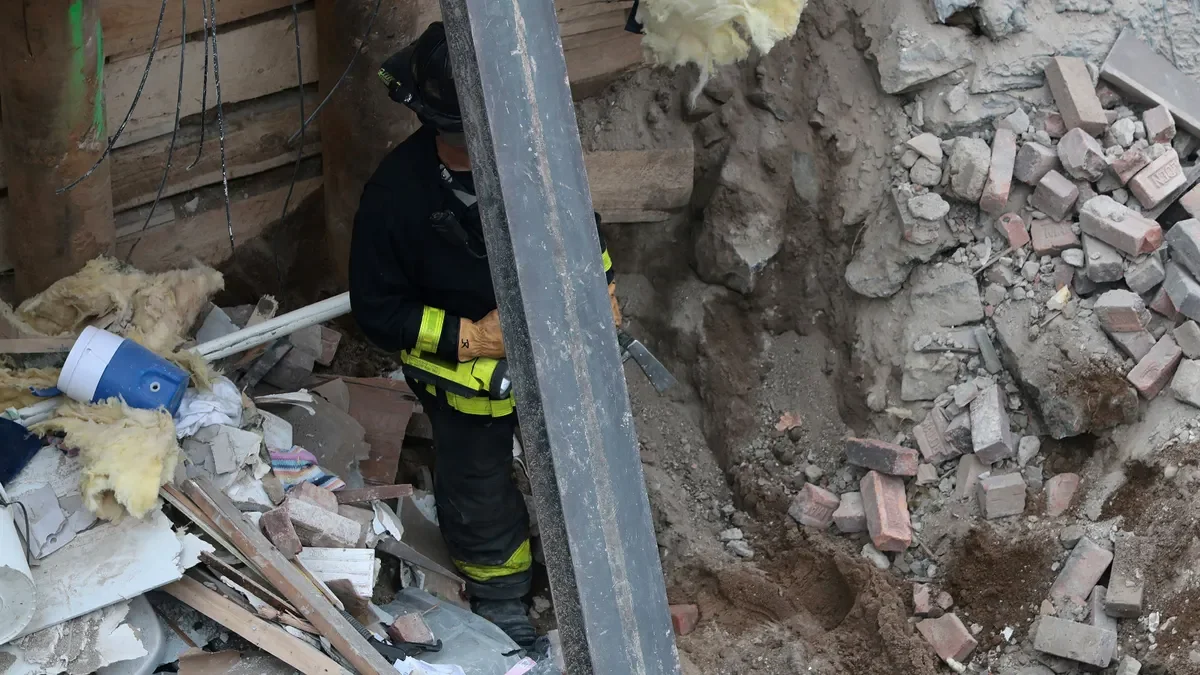
The Fire Department of New York is still in search and rescue mode, said Commissioner Lillian Bonsignore during Thursday's press conference.
Mamdani used part of his remarks to thank first responders, but he also singled out the construction crews caught in the initial collapse. "Construction workers who had only barely survived themselves turned back and dug victims out of the rubble," Mamdani said. "People are alive today because of their heroism yesterday."